
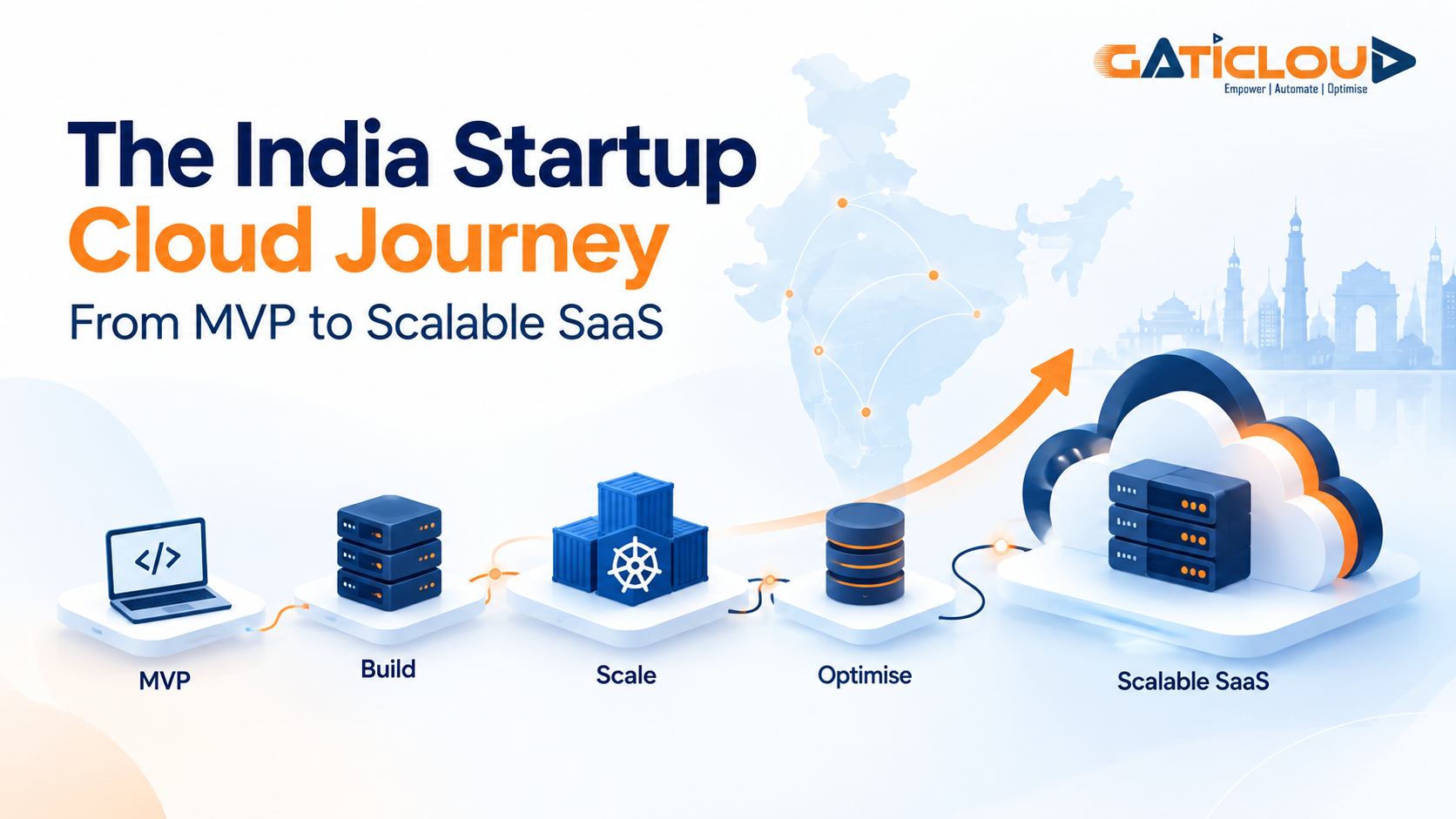
There is a moment in almost every startup’s journey when the conversation changes.
In the beginning, the questions are simple:
Can we build it?
Will people use it?
Can we get our first 100 customers?
Infrastructure is rarely the headline.
A founder might start with a single application server, a database, a Git repository and a deployment process that is partly automated and partly held together by a few commands that everyone on the team knows.
And honestly, that can be perfectly reasonable.
An early-stage startup does not need enterprise-grade infrastructure on day one.
But then something changes.
Users arrive.
Traffic increases.
The development team grows.
A customer asks where their data is hosted.
A database becomes business-critical.
A deployment that once took ten minutes suddenly feels risky.
And one morning, someone asks the question every growing SaaS company eventually has to answer:
“Can our infrastructure scale as quickly as our business?”
That is where the Indian startup cloud journey really begins.
India’s Startup Story Is Becoming a Cloud Story
India’s startup ecosystem has moved well beyond a handful of technology hubs. The 2026 Startup India ecosystem report describes India as having more than 200,000 DPIIT-recognised startups, with 53% located in Tier-2 and Tier-3 cities. It also highlights the increasing spread of entrepreneurship beyond the country’s traditional metropolitan centres.
At the same time, cloud infrastructure is becoming a much larger part of how Indian businesses build and scale. Gartner forecasts that public-cloud spending in India will reach $17.5 billion in 2026, growing 28.1% from 2025. Infrastructure-as-a-Service is forecast to be the fastest-growing major segment, at 40% growth in 2026.
For startups, this doesn’t simply mean spending more on cloud. It means something more important:
Infrastructure is becoming part of the product strategy.
Stage 1: The MVP – “Just Get It Working”
Every startup starts somewhere.
Perhaps you’re building:
- a B2B SaaS platform
- a fintech application
- an AI-enabled product
- an e-commerce platform
- a healthcare application
- a developer tool
At this stage, speed matters. Your team is validating an idea, not operating at millions of requests per second.
A simple architecture might look like:
Users → Application → Database
One or a few virtual instances may be enough.
The priority is usually:
Build → Launch → Learn → Iterate
And that’s okay.
The mistake is not starting simple.
The mistake is assuming that the infrastructure that worked for the MVP will automatically work for the business that comes after it.
Stage 2: Product-Market Fit – “People Are Actually Using It”
Then the numbers start moving.
Your user base grows.
Your database gets larger.
Your application receives traffic at different times of the day.
Your developers are deploying more frequently.
Suddenly, infrastructure decisions start affecting development velocity.
A deployment that once happened once a week may now happen several times a day.
This is where startups begin moving from:
“Where can we host this application?”
to:
“How should we engineer the environment in which this application runs?”
This distinction matters.
A scalable SaaS platform needs more than computing power.
It needs:
- repeatable deployments
- reliable databases
- backups
- monitoring
- access controls
- predictable environments
- a plan for traffic growth
- a recovery strategy
This is often where DevOps practices begin to become genuinely valuable.
Stage 3: Growth – When Kubernetes Starts Making Sense
Kubernetes is frequently presented as something every modern startup should use. We don’t believe that.
Kubernetes is a tool, not a milestone.
If your application is simple and a virtual instance meets your requirements, introducing Kubernetes may create unnecessary operational complexity. But as your architecture becomes more distributed, Kubernetes can become useful.
For example, imagine a SaaS platform that has evolved into:
Web Application
↓
Authentication Service
↓
Payment Service
↓
Notification Service
↓
Analytics Service
↓
Database + Cache
Now the team may need to manage multiple containerised workloads, scaling requirements and deployment processes. This is where managed Kubernetes can become valuable.
GatiCloud’s Managed Kubernetes service is designed to run production-grade clusters while handling control-plane complexity, with capabilities including high availability and autoscaling. It can also work with standard Kubernetes tooling such as kubectl and existing CI/CD pipelines.
The objective isn’t to use Kubernetes because it is fashionable. The objective is to use it when the application’s operational complexity justifies it.
Stage 4: The Database Becomes the Business
There is another transition that founders often underestimate. Your application can be restarted.
Your infrastructure can be rebuilt. Your database is different.
Once your platform contains customer accounts, transactions, analytics, business records or application state, the database becomes one of your most important assets. That changes the infrastructure conversation.
You start asking:
- Are backups automated?
- How quickly can we recover?
- What happens if a database instance fails?
- Who has access?
- Can we scale the database as usage increases?
- Where is the data hosted?
These aren’t questions reserved for large enterprises. They become relevant the moment the data becomes important to customers.
GatiCloud’s Managed Database service supports MySQL, PostgreSQL, Redis, MariaDB and MongoDB, with features including automated backups, failover, private networking and encryption in transit and at rest.
For a growing SaaS company, the value is not simply “having a database.” It is reducing the amount of operational work the engineering team has to carry themselves.
Stage 5: Security Stops Being a Future Problem
Early-stage teams often think: “We will address security when we get bigger.” Growth has a habit of arriving before the security roadmap. The moment your startup begins handling customer information, business data, credentials or sensitive workloads, security becomes part of the infrastructure conversation. And modern cloud security is not one product.
It is a combination of:
Identity
→ Who can access the environment?
Infrastructure
→ Where are workloads running?
Application
→ Is the software secure?
Data
→ How is information stored and protected?
Monitoring
→ Can suspicious activity be detected?
Recovery
→ What happens if something goes wrong?
This is also why DevSecOps matters. Security shouldn’t suddenly appear at the end of the deployment process. It should increasingly become part of how software is built, tested, deployed and operated.
Stage 6: The First Serious Traffic Spike
Here is a situation many startup teams eventually encounter. Your product gets featured. A campaign goes live. A customer launches a large deployment. Or an unexpected event sends significantly more traffic to the application.
Suddenly:
Traffic ↑
CPU ↑
Memory ↑
Database connections ↑
Response time ↑
And the team starts watching dashboards. This is when scalability stops being a theoretical architecture discussion. It becomes a customer experience issue.
The right question isn’t simply:
“Can our server handle more traffic?”
It is:
“Can our infrastructure respond to changing demand without becoming a bottleneck?”
Depending on the workload, that may involve:
- scaling compute resources
- load balancing
- caching
- database optimisation
- container orchestration
- autoscaling
- application-level optimisation
- monitoring and observability
GatiCloud’s cloud portfolio is designed around these kinds of evolving workloads, with virtual instances that can be scaled from development to production and managed Kubernetes with autoscaling capabilities.
Stage 7: Infrastructure Becomes a Competitive Decision
At some point, infrastructure is no longer just an engineering concern.
It affects:
- Customer experience
- Development velocity
- Operational costs
- Security
- Reliability
- Data governance
- Enterprise readiness
- Expansion into new markets
This is particularly relevant in India, where cloud adoption is increasingly connected to application modernisation, digital services, scalability and business resilience. Gartner identifies application modernisation, digital sovereignty and scalable consumption models among the factors driving India’s cloud investment.
For an Indian SaaS company, therefore, choosing cloud infrastructure is not simply about choosing where a server sits. It is about deciding what kind of company you want your infrastructure to enable you to become.
So, What Does a Scalable SaaS Architecture Actually Look Like?
There isn’t one architecture that works for every startup. But a mature SaaS environment often starts looking something like:
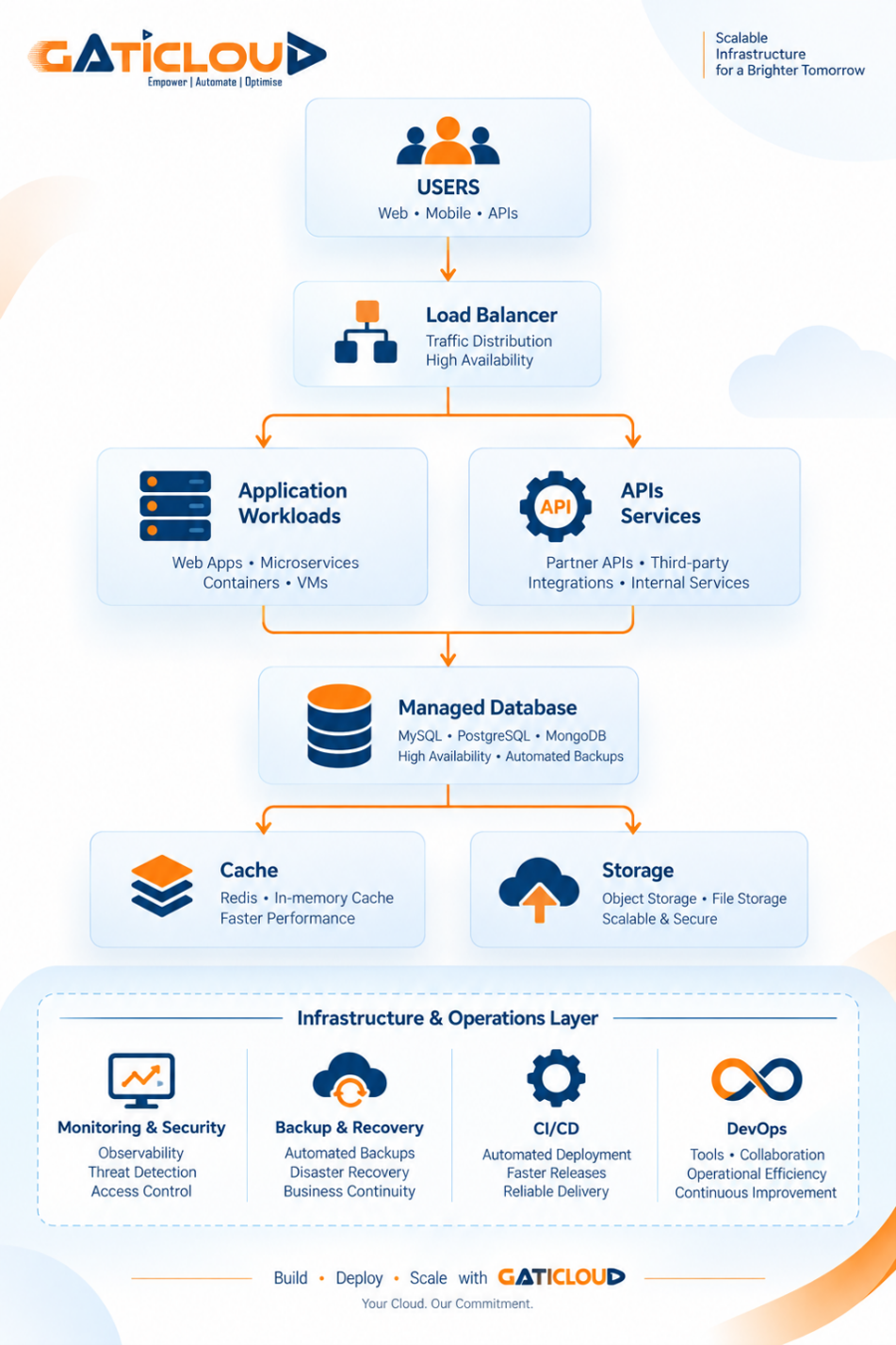
The architecture will change depending on the product. But the principle remains:
Build only as much complexity as your business needs and make sure the foundation can evolve when the business does.
Where GatiCloud Fits Into This Journey
This is where our perspective at GatiCloud comes from. We don’t believe every startup needs the same infrastructure on day one. A developer testing an MVP has different requirements from a SaaS company serving thousands of customers. A growing team may need a different architecture six months later. Our goal is to provide the building blocks that can support that progression.
GatiCloud offers:
Virtual Instances
For applications that need secure, scalable cloud compute across development and production environments. GatiCloud states that instances can be launched in under 60 seconds and offers multiple configurations for different workload requirements.
Managed Kubernetes
For teams running containerised applications and microservices that need orchestration, high availability and autoscaling without taking on every control-plane responsibility themselves.
Managed Databases
For teams that want managed database operations, automated backups, failover, private networking and encryption while focusing their engineering resources on the product.
Developer Tools
GatiCloud provides pre-configured tools including Jenkins, GitLab, Docker, Portainer, Apache Airflow, Node.js, Django and Spring Boot, allowing development teams to connect these tools with their cloud infrastructure and streamline deployment workflows.
India-focused Cloud Infrastructure
For businesses that care about where their workloads and data are hosted, GatiCloud also positions its infrastructure around India-focused hosting and data sovereignty.
The Question Founders Should Ask
The question isn’t:
“Which cloud is the biggest?”
It isn’t even:
“Which cloud is cheapest?”
The better question is:
“What infrastructure does my business need today and how easily can that infrastructure evolve when my business changes?”
Because your infrastructure should not force you to choose between:
building fast and building properly.
The goal is to create a foundation that lets your engineering team spend more time improving the product and less time fighting infrastructure problems.
From First Deployment to the Next Million Users
Every startup has a different journey. Some remain lean. Some become global SaaS platforms. Some pivot. Some build products that nobody expected. Some scale much faster than planned. The infrastructure underneath them has to be ready for that uncertainty.
And that is perhaps the most important lesson we’ve learned from the cloud journey:
You don’t need to build for millions of users on day one. But you should build a foundation that doesn’t prevent you from reaching them.
At GatiCloud, that’s the infrastructure journey we want to support:
MVP → Product-Market Fit → Growth → Scale → Resilience
Not with unnecessary complexity. Not with infrastructure for infrastructure’s sake.
But with practical cloud building blocks that grow alongside the business.
Building Your SaaS on GatiCloud?
If you are currently running an MVP, preparing for your first major customer, migrating an existing SaaS platform, or rethinking your infrastructure for the next stage of growth, let’s have a conversation.
Tell us where you are today.
We will help you think through where your infrastructure needs to go next.
Explore GatiCloud’s cloud services: https://gaticloud.in/services/
Or Talk to GatiCloud team: https://gaticloud.in/contact-us/
GatiCloud – Cloud infrastructure for businesses ready to build, scale and grow.
